
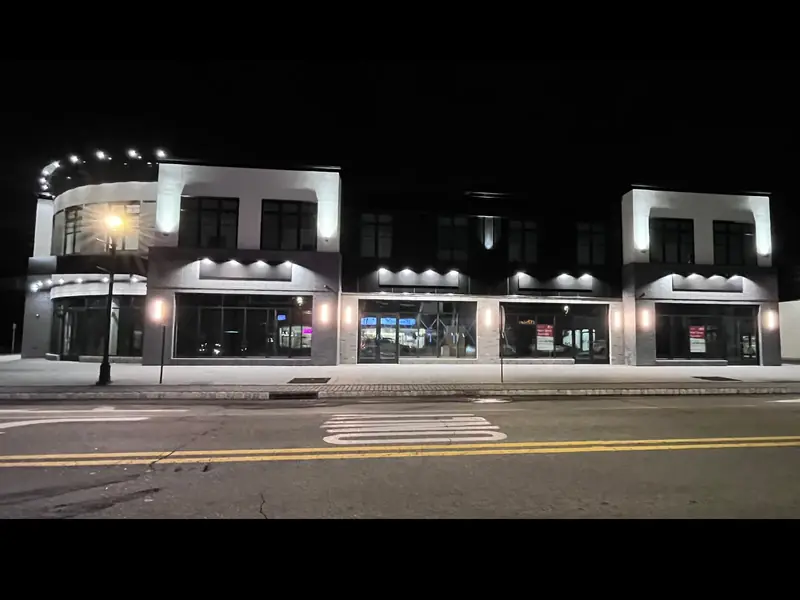
Services · Parking Lots
Parking lot lighting design
Retail plazas, restaurants, hotels, office parks, medical offices, houses of worship and multi-family communities.
Parking Lot Lighting Design
Light where people walk, not on the neighbors
A parking lot is the first and last part of a visit. Customers and tenants judge a property by how it feels to walk from the car to the door after dark. Planning boards judge it by how much light crosses the property line.
Lighting by Design is a New Jersey lighting design firm, founded in 2009, with decades of experience behind it. We design parking and site lighting for commercial properties: light levels, pole positions, fixtures and controls, planned on paper before anything is ordered. We are designers and consultants, so the plan is built around the site and the owner, not around a product line. Parking areas are one part of our wider commercial lighting design work.
Why owners call us
Dark spots, glare and complaints
Most parking lot problems fall into a few groups:
- Dark corners and bright hot spots. Industry guidance limits the ratio between the brightest and darkest points in a lot so the eye can see into the darker areas from the brighter ones. A lot with a few very bright poles and dim gaps between them can feel less safe than one with less light spread evenly.
- Glare. Light aimed too high gets in drivers' eyes and washes out what security cameras see.
- Light trespass. Many New Jersey towns cap how much light may reach the property line, often lower still next to homes. A complaint from a neighbor can stall a site plan.
- Old fixtures and high bills. Older metal halide and sodium lots are prime candidates for LED. A U.S. Department of Energy demonstration cut energy use by about half with LED alone, and further with well-set sensors.
- Liability worries. Owners want reasonable, documented lighting for the people who use their lot at night.
Standards
Designed to the numbers the town asks for
Parking lighting is measured, not guessed. The Illuminating Engineering Society (IES) publishes recommended minimum light levels and uniformity ratios for parking areas, with higher targets where security is a concern. Those numbers are calculated as maintained values, meaning what the lot will see after the fixtures age, not on day one.
Local ordinances often go further. Across New Jersey, codes we reviewed call for fully shielded or full-cutoff fixtures, set maximum light levels at property lines, require lighting to dim or shut off after business hours, and ask for a point-by-point photometric plan with the site plan application. The specifics change from town to town, so we start with the local code.
We select fixtures by their BUG rating (backlight, uplight and glare). Low backlight fixtures near the property line keep light off the neighbors. Zero uplight fixtures keep it out of the sky. We follow DarkSky-friendly practice: warm color temperatures where they suit the site, shielded optics and dimming during late hours.
Security and safety
A lot that is safer, not just brighter
Poor lighting causes real problems in a parking lot. People trip on curbs, wheel stops and uneven pavement they cannot see. They slip on ice that looks like wet asphalt. Drivers miss pedestrians stepping out between parked cars. Dark corners and shadowed doorways give someone a place to hide. Good lighting reduces those risks.
That takes even light with no deep shadows, not just bright poles. IES guidance limits the difference between the brightest and darkest spots for this reason, and calls for higher light levels where security is a concern. We pay close attention to entrances, walkways, stairs, curbs, crosswalks, the far corners of the lot and the spaces between parked cars. We light faces, not just the pavement, so people can see who is around them. Where there are security cameras, we place and aim fixtures so the cameras get clear, even light without glare washing out the picture.
The result is a lot lit evenly to a recognized standard, with a plan on file that shows how.
Light spill and town code
Light that stays on your property
Light spill, also called light trespass, is light that crosses the property line into neighboring yards, windows and streets. It is one of the most common complaints a town hears about a parking lot, and one of the most common reasons a lighting plan gets sent back by a planning board.
We plan for it from the start. Pole positions, mounting heights, fixture optics and shielding are chosen so the lot is lit and the neighbors are not. Glare toward drivers on the road gets the same attention. Before anything is ordered, the photometric plan shows the calculated light level along every property line, so you can see the result on paper.
Every New Jersey town writes its own lighting rules. Some set a maximum light level at the property line, some require full-cutoff fixtures, some limit pole heights or color temperature, and many require lights to dim or turn off after business hours. We read the ordinance for your town and design the lot to meet it, so the plan is ready for planning board review and the finished lot stays in compliance.
What we do
From site plan to switched on
- Site review. We walk the lot at night where possible, look at existing poles and dark spots, and review the site plan, entrances, walkways and camera positions.
- Photometric layout. We model the lot in lighting software to set pole positions, mounting heights and fixture optics, and check light levels, uniformity and property-line spill against IES guidance and the local code.
- Fixture selection. We choose fixtures for distribution, BUG rating, color, finish and budget, and match poles and heads to the building and any facade and exterior lighting.
- Controls. Photocells, timers, dimming and motion sensors can cut energy use substantially, but federal field studies show savings depend on sensor coverage and correct settings. We specify the settings, not just the hardware.
- Coordination. We work with the owner, architect and site engineer so pole bases, islands and conduit routes line up with the civil drawings, and we see the job through to a final walkthrough.
Retrofits
LED upgrades that look planned
We retrofit old and broken lighting as well as new lots. Swapping old heads for new LED heads one for one often keeps the original dark spots and adds glare. A retrofit is a chance to check light levels, fix uniformity, reduce the number of fixtures where possible and add dimming. We can also take night-time light readings of an existing lot to show where it falls short.
The whole site
One design from the curb to the front door
The lot connects to drives, walkways, entrances and signs. For hotels and venues, the drop-off and arrival matter as much as the parking. Our work at the Marriott in Saddle Brook covered the drop-off area, the entryway and the walkways, and we designed the exterior lighting for a shopping center in Cresskill. We have done many parking lots. Hotels and venues have their own page: hotel and hospitality lighting design. Restaurants can see restaurant lighting design.
Not sure what your lot needs yet? Start with a lighting consultation. Call 516-655-6126 or email lightingnj@gmail.com.
Properties
Shopping centers & plazas · Restaurants · Hotels & catering halls · Office buildings & office parks · Medical offices · Churches & houses of worship · Apartment & HOA communities
What we design
Light levels & uniformity · Pole placement & mounting height · Fixture & optic selection · Glare & light trespass control · Dimming, sensors & timers · Lighting plans for site plan review
What’s included
On-site evaluations · Design concepts · Lighting layouts · Specification · Supervision
Portfolio
Site & exterior projects
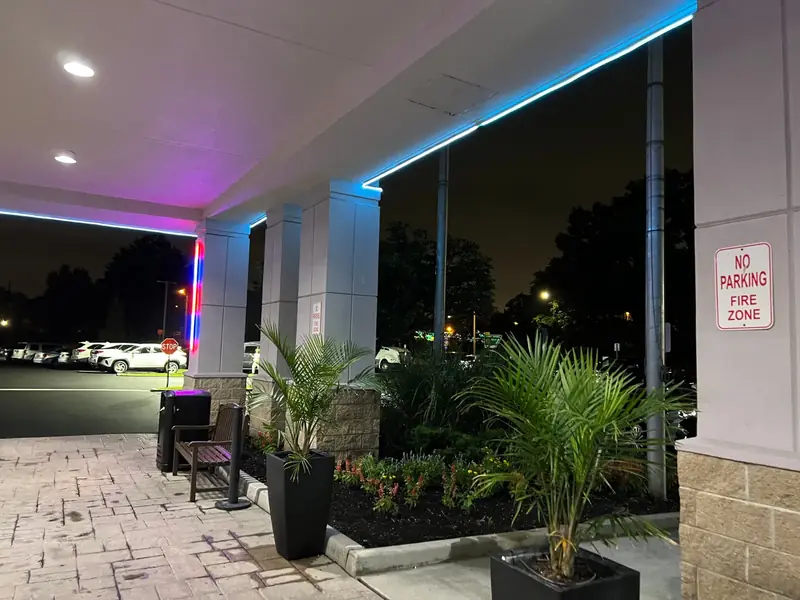 Marriott Drop-Off Area · Saddle Brook, NJ
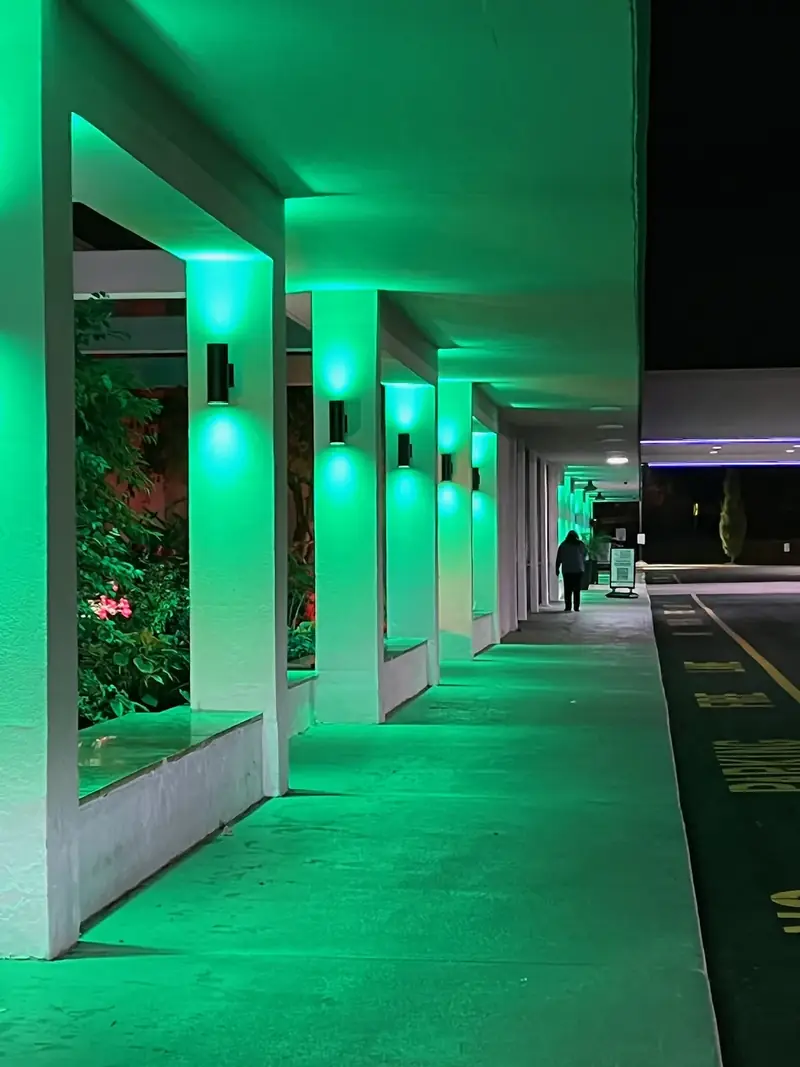 Marriott Entryway · Saddle Brook, NJ
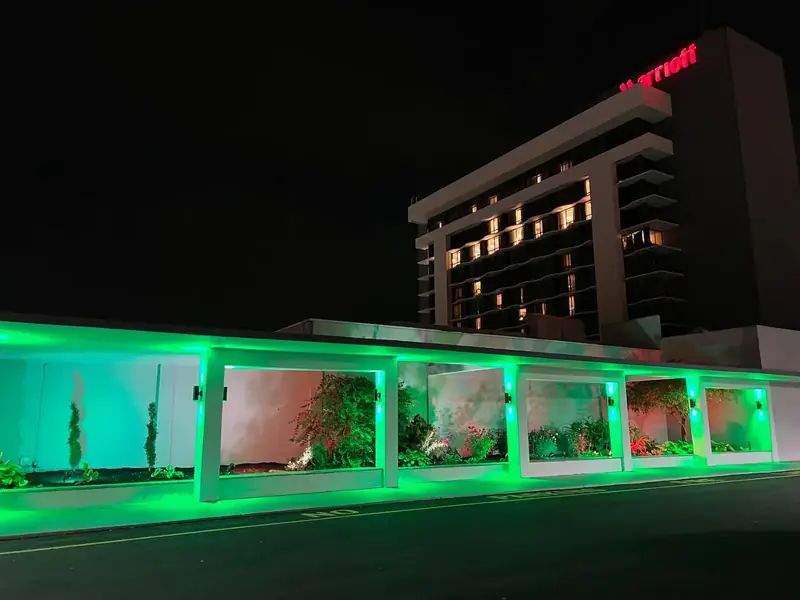 Marriott Walkway · Saddle Brook, NJ
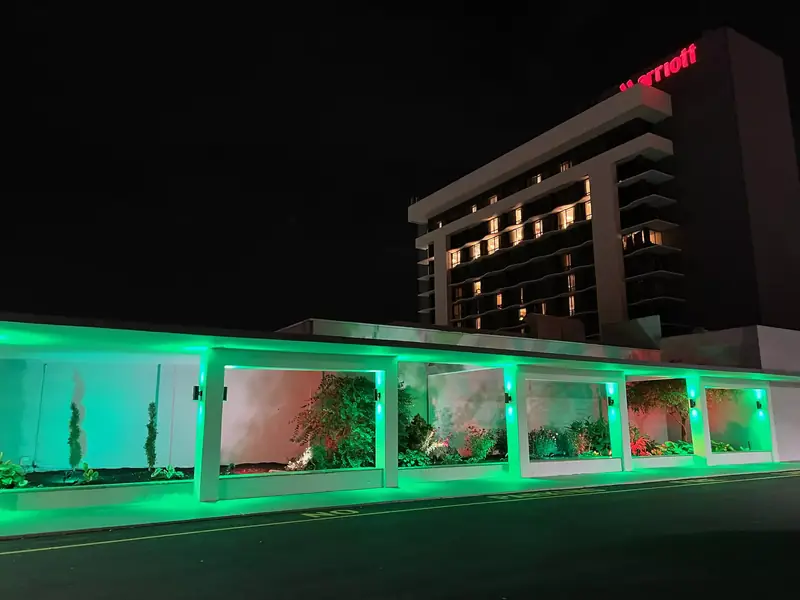 Marriott · Saddle Brook, NJ
What goes into a photometric plan, and how it differs from a home lighting plan: what is a lighting plan. Office buildings: office lighting design.
Parking Lots FAQ
How much light does a parking lot need?
IES guidance sets minimum light levels and a maximum ratio between the brightest and darkest spots, with higher targets where security is a concern. Many New Jersey towns set their own minimums, maximums and uniformity ratios, so we design to whichever is stricter for your site.
What is a photometric plan?
A drawing that shows calculated light levels across the site on a grid, along with fixture locations, mounting heights and specifications. Many planning boards require one with a site plan application to show the lot is lit evenly and light stays on the property.
How do you keep light off neighboring properties?
By placing poles with the property line in mind, choosing fixtures with low backlight and glare ratings, using shielded optics and dimming late at night. We check the result at the property line in the photometric calculation.
Do LED parking lot lights really save money?
Usually, yes. Federal studies of LED conversions have shown large energy reductions, and well-set dimming and sensors add more. Results depend on the design, so we size fixtures and controls to the actual lot.
Can better lighting help our security cameras?
Even light with low glare gives cameras cleaner images and fewer silhouettes. We review camera positions with the lighting layout so poles and fixtures support them.
Will the lighting meet our town's ordinance?
Yes. We review your town's lighting ordinance and site plan rules first, then design to them, including limits on light spill at the property line, fixture shielding and after-hours dimming. The photometric plan documents the result for the planning board.
Do you repair or maintain parking lot lights?
No. We are lighting designers and consultants. We plan new lighting and LED upgrades, and the plan can be carried out by your own team or the trades you already work with.
Do you work on new construction and existing lots?
Yes. For new sites we coordinate with the architect and site engineer during site plan review. For existing lots we assess what is there and plan the upgrade.
Where we work: Atlantic County · Bergen County · Essex County · Hudson County · Middlesex County · Monmouth County · Morris County · Ocean County · Passaic County · Somerset County · Sussex County · Union County
Free Design Consultation
Let’s talk about your project
Call us to discuss your project, or request a free consultation and we’ll be in touch.
Request a Consultation